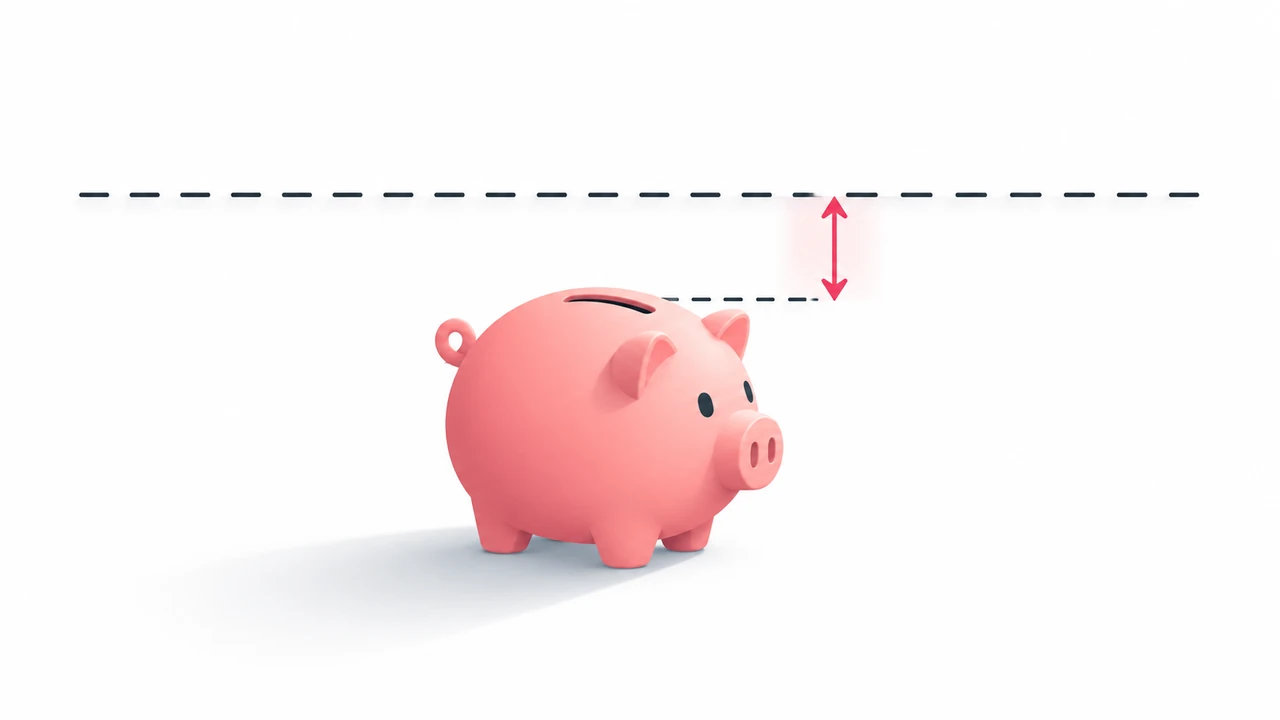
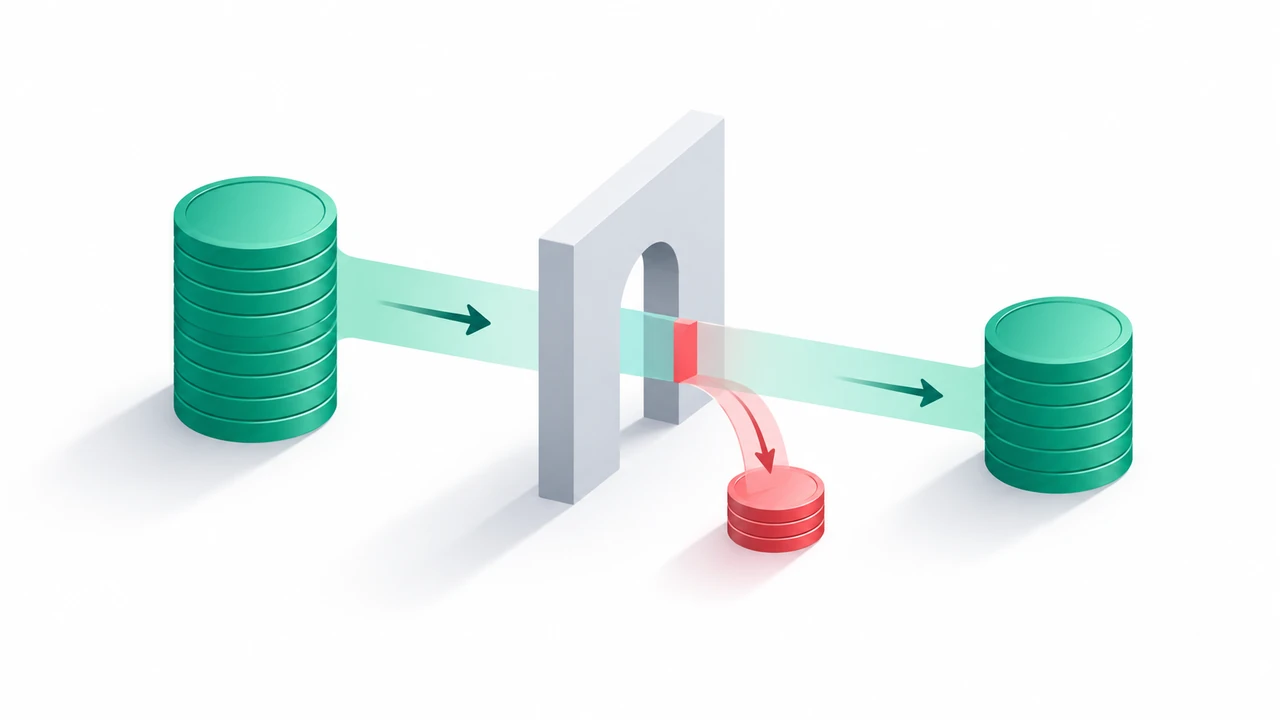
A withdrawal fee is rarely one charge, and the figure printed beside the word fee on a cashier page is usually the smallest of the four that reach your money. An operator charge, the rail's own cost, any intermediary that handles the payment in transit, and the rate applied when one currency becomes another all land on the same payout. Three of those are disclosed somewhere if you go looking; one almost never is. This page separates them and shows how to add them up using figures you read yourself.
Pokies Cashout · Payments and terms referencePublished Last reviewed Promotion figures supplied by site owner: 5 October 2026
Charges stacked
Four, from four different parties
Least disclosed
The currency spread — a rate, not a line
Operators
Offshore — not AU licensed
Audience
18+ only
The four separate charges stacked inside one payout
Four charges can attach to one withdrawal, levied by four parties that do not coordinate. The operator charges for releasing the payment, the rail charges for carrying it, any intermediary that touches it in transit takes a cut, and whoever converts the currency applies a rate away from the mid-market one.
They do not arrive together, which is why three go unnoticed. The operator charge is deducted before release, so it shows as a smaller sent amount rather than a bill. Rail costs are sometimes deducted and sometimes absorbed. Transit deductions happen after the operator stops watching, and a conversion is a rate, so there is no line item to query.
Order of operations decides the total and nobody discloses it. A charge taken from the gross reduces the base that later percentages apply to; one added afterwards does not. An operator that deducts then converts and one that converts then deducts produce different arrivals from identical published figures.
So there is no such thing as the withdrawal fee. There is an arrival amount, and the only answerable question is what it will be for the sum you request, down the route you use, on the day you use it. No operator's schedule appears here: those figures are revised without notice, and a stale number is worse than none because it gets used with confidence.
Sponsored partners · Display order is not an independent ranking.
18+ only. Availability depends on your location and eligibility. Any promotion is subject to the operator's live terms, including wagering, eligible games, maximum bets, expiry and cashout limits where applicable. Deposit and withdrawal methods, processing times and limits are set by the operator and its payment providers and are not guaranteed here. Offshore operator; not licensed to offer online casino services in Australia. Gambling involves financial risk. Checked: 2026-10-05. 18+. Gambling involves financial risk.
18+ only. Availability depends on your location and eligibility. Any promotion is subject to the operator's live terms, including wagering, eligible games, maximum bets, expiry and cashout limits where applicable. Deposit and withdrawal methods, processing times and limits are set by the operator and its payment providers and are not guaranteed here. Offshore operator; not licensed to offer online casino services in Australia. Gambling involves financial risk. Checked: 2026-10-05. 18+. Gambling involves financial risk.
The operator's own charge and the shapes it takes
The charge the operator keeps for itself comes in a few recognisable shapes, and the shape tells you more than the number attached to it. A flat amount per withdrawal. A percentage of the amount. A free-withdrawal allowance with every payout beyond it charged. A charge on one method family while others are free. Or a charge that applies only below a stated amount.
Flat and percentage schedules run in opposite directions. A flat charge is punishing on small amounts and trivial on large ones; a percentage is proportionate everywhere, predictable but expensive at the top end. Withdraw small amounts often and a percentage schedule is usually cheaper; withdraw rarely and in size and the flat one is.
Free-withdrawal allowances reset on a cycle, and the cycle is rarely stated: one free payout per calendar month is a different instrument from one per rolling seven days. A per-request cap can consume the allowance entirely, as the withdrawal limits guide sets out.
Other charges apply only under conditions set out in the payments clause rather than the cashier page — a payout from an account that has not completed identity review, a withdrawal of a deposit never wagered, a payout to a method other than the one deposited from, an administration charge on an idle balance. Where clause and cashier page disagree, the clause governs and the page is merely current.
The operator's own charge and the shapes it takes
What each payment rail costs to carry the money
The rail's cost is structural and does not care who the operator is. Domestic account-to-account credits in Australia are cheap to deliver, and whether your own bank charges you for receiving one is answered in that bank's published fee schedule rather than anywhere on a cashier page, which is what makes the family worth checking first on cost. Addressing a payment by PayID identifies an account rather than changing the price.
Card payouts carry a per-transaction cost to whoever sends them, because they travel over a scheme payout service rather than as a refund of anything, and whether that cost reaches you is the operator's decision. The variant to watch for is a credit posted back against the original authorisation, which can sit as a pending line before it posts.
International wires tend to be the dearest family and are the only one with an arrival amount nobody can state in advance, because they route through institutions neither party chose; the sending bank's and your bank's own schedules are where the figures are published. E-wallets compress the journey into two charged steps — receiving into the wallet, then withdrawing from it to your bank — each with its own schedule and often its own conversion.
Crypto payouts carry two charges that get confused. The network fee is what the chain costs at the moment of broadcast; the operator's payout deduction is a figure it publishes for itself and need not match it, and the gap belongs to the operator. Several voucher methods are deposit-only by design, which is not a fee but forces a second method at the worst moment.
Sponsored · WinCrown · 18+
200 free spins on selected slots
WinCrown free-spin offer. Check the eligible slots, qualifying deposit and full promotion conditions.
Correspondent banks: the deduction taken in transit
An international wire does not travel directly from the sending bank to yours. It passes through correspondent institutions that hold accounts with one another, each with its own schedule. A deduction taken at a hop reduces the amount that continues, so what arrives can be less than what was released with nobody having erred.
Wire practice lets the sender choose who bears those charges, expressed as three standard instructions: the sender pays all, the charges are shared, or the beneficiary pays everything. You are not the sender. The instruction is set by the operator or its bank, you are not told which was used, and you infer it from what turns up.
That makes a wire's arrival unknowable in advance, unlike the other three charges, which can be read off a page before you commit. Treat a wire figure as a ceiling, avoid the family for small payouts where a fixed deduction dominates, and use it for amounts large enough that transit deductions are a rounding error.
Evidencing a transit deduction takes two documents: the released amount and reference from the operator, and the remittance advice from your bank. The difference is your transit cost. Raise it with neither party — a correspondent bank's deduction is not something the operator can reverse and not something your bank levied.
Conditions are published by the operator and change without notice. Read the live page before you act on anything here.
The conversion rate is the largest charge nobody calls a fee
A conversion has two numbers: the mid-market rate, the midpoint between what the market is paying and asking, and the rate you received. The distance between them is the margin, and it is a charge. It is not presented as one because there is nothing to present — a rate was quoted, the rate was applied, the transaction completed as described.
Conversion can happen in up to five places on one round trip, each able to take a margin. At the operator, crediting an Australian dollar deposit into an account denominated in something else. At the operator again on the payout. At the card scheme on a cross-border transaction. At your bank, on an inbound foreign credit. And at an exchange or wallet service.
Two conversions on a round trip is the normal case and the costliest feature of an operator that does not hold your balance in your own currency. It is also the hardest to notice, because the margins are taken months apart on different amounts and neither is itemised. A player who tracks fees diligently and ignores conversion can be carrying a cost several times the size of everything being tracked.
You can measure a margin afterwards. Record the date and time and the exact amounts on both sides, look up the mid-market rate for that timestamp from an independent source, then divide the rate you received by it; the shortfall is the margin as a percentage. Do it once per route and the arithmetic below has a real figure in it.
The conversion rate is the largest charge nobody calls a fee
Working the sum with your own figures on a sheet of paper
The method is four lines. Write down the gross amount you intend to request. Subtract the operator charge in whichever shape it takes. Subtract or allow for the rail charge, including the second leg if a wallet is involved. Then apply the conversion margin you measured to whatever is left. The result is the arrival amount.
The figures below are suppositions showing the shape of the arithmetic, not any operator's charges — substitute your own. Suppose a flat charge of ten units per withdrawal and no inbound charge at your bank. A request of two hundred arrives as one hundred and ninety, a cost of five per cent. The identical charge on one thousand costs one per cent.
Percentages compound in sequence. Suppose an operator charge of two per cent and a measured margin of one and a half per cent, in that order. One thousand becomes nine hundred and eighty, and the margin applies to that rather than to the thousand, leaving nine hundred and sixty-five and thirty cents. Adding the percentages instead gives a third figure.
Caps multiply flat charges, and this is the largest avoidable cost here. A per-request cap of five hundred against a balance of two thousand, with the same flat ten, means four charged requests totalling forty — two per cent of the balance from a schedule headlined as a flat ten. The crossover is one division: a flat ten equals two per cent at five hundred, so below that the percentage schedule costs less.
Sponsored · Safe Casino · 18+
+250% welcome bonus
Safe Casino welcome offer. Check the qualifying deposit, bonus cap, wagering and eligibility before accepting.
Caps, instalments, and why the small withdrawal is the expensive one
A per-request cap does not slow one payout down; it converts one payout into a series, and each request is ordinarily a separate chargeable event. Unless the terms say a capped balance leaving in instalments is charged once, assume every instalment is charged, and check the figure on the second.
The interaction with a free-withdrawal allowance is where this gets expensive. One free payout per period against a balance needing four requests means one free and three charged inside that period. Spreading them out preserves the allowance and pays for it in weeks of waiting, during which the balance stays reachable — and a balance you can reach is one the reversal mechanic can take back.
Every fixed charge here is measured as a proportion of the amount it is taken from. A deduction negligible against a four-figure payout can take a double-digit percentage of a small one. Where a minimum withdrawal amount exists and a charge applies at that floor, the proportional cost at the minimum is the worst rate available on that route.
Under a flat schedule, then, fewer and larger requests always cost less, and banking winnings in frequent small amounts is the most expensive pattern available. Under a percentage schedule the count is irrelevant. The opposite error is letting a balance accumulate until the request is large enough to attract additional review, as the large win payout rules describe.
Charges that exist but are never called withdrawal fees
A returned payment is the common one. A payout sent to an incorrect BSB or account number, to an account in a different name, or to a closed account will usually come back, and the return can carry a charge from the rail, the operator, or both. Verifying the destination first costs nothing.
Cancelling and re-submitting is often described as free, and whether a charge attaches is answered in the payments clause rather than assumed, but either way it has a cost: the request goes back to the start rather than resuming, so the price is paid in days. The same applies to editing the payout destination mid-request. Either can be the right call, understood as beginning again.
Administration charges against idle balances exist in offshore terms and are easy to miss because they sit outside the payments section. They typically require a stated period of inactivity and then apply periodically against whatever is left. The defence is not to leave a balance in an account you have stopped using.
Charges arising from a disputed card transaction are their own category and can be far larger, alongside the account consequences — the chargebacks page covers why a dispute is a poor instrument for recovering a gambling payment. The last charge is already behind you: if an Australian dollar deposit was converted when credited, a margin was taken then.
What a fee-free withdrawal claim actually excludes
Fee-free, no fees and free withdrawals are claims about one of the four charges here: that the operator is not levying its own. They say nothing about what the rail costs, what an intermediary deducts, or what margin a conversion takes — and the margin is frequently larger than the charge being waived.
The qualifiers are where the rest of the claim lives. Fee-free on your first withdrawal. Fee-free above a stated amount. Fee-free on one named method while others carry a schedule. Fee-free once identity review is complete. Fee-free a certain number of times per period. Each is accurate, and each makes the headline inapplicable to some withdrawal you will want to make.
A fee claim is checkable when you could catch it being wrong. Five things would have to be stated: which charge is waived, which methods and account states it covers, whether an amount threshold applies, how many payouts per period it extends to, and when it was last reviewed by someone able to change it. A claim missing all five is unfalsifiable rather than false.
Claims also age without being edited. Payment providers get swapped, a method is withdrawn for a region, a finance arrangement changes, and none of that arrives with an announcement. A fee line accurate when it was transcribed into a comparison table, this site's included, can be wrong for months while continuing to look authoritative.
Where the authoritative figure lives and which version governs
The operator's figure exists in three places of unequal weight. The cashier or banking page inside your account is the most current. The payments clause in the terms governs if the two disagree. A written answer from support is the one with a date and a name attached, which is why it is worth obtaining before a large payout.
Where the question comes up at Safe Casino or WinCrown, the charge is set out in each site's own banking or cashier area rather than anywhere on this page, and what it says there on the day you request a payout is the only version that governs.
Your own institutions publish schedules too, and these are easier to obtain because they are not marketing documents. Australian banks publish fee schedules covering inbound international credits, conversion and any handling charge on a foreign credit. If the route ends at an exchange or wallet service, that provider's crediting policy is a fourth document, and some restrict funds arriving from a gambling source outright.
Then make a record. A dated screenshot of the cashier page showing the charge turns a later disagreement from an argument about memory into a comparison of two documents. Note the gross requested, the charge stated, the released amount, the arrival amount and the date of each — five lines per withdrawal, and after three you know your own route better than any published table.
Choosing a route on the arrival amount, not the headline
The decision rule follows from the arithmetic. For small and frequent payouts, favour a route with no fixed charge at any step — in practice a domestic account-to-account credit where the operator supports one. For large and infrequent payouts, fixed charges stop mattering and the question is which route applies the smallest percentage, usually the conversion margin.
Closed-loop rules can remove the choice entirely. Many operators return funds down the rail that delivered them, or require the deposit method for payouts up to the deposited amount. So the cheapest payout route is frequently decided by a deposit decision made weeks earlier by someone comparing deposit speed. Choose the payout route first and let it dictate the deposit.
Cheapest and fastest are different routes. A route with no fixed charge may sit behind more operator-side stages; a quick one may carry a per-transaction cost, and what fills the waiting is set out in the withdrawal times arithmetic. Two further questions belong elsewhere: which operators carry which charges sits with pokiesledger.com (operator shortlists and bonus offers), and how a game is built and how its volatility behaves sits with pokiesalmanac.com (game mechanics, RTP, volatility).
Three things are deliberately not asserted. No operator's charges, because they change without notice. No typical or average fee, because the four charges combine differently on every route and an average would describe nobody. And no suggestion that any of this is licensed in Australia: online casino services cannot lawfully be provided to people in Australia, and every operator referred to here is offshore. Gambling is for adults only, and if money leaving an account has stopped feeling like an administrative question, free and confidential support is available on 1800 858 858.
The four separate charges stacked inside one payout — at a glance
Questions people actually ask
Do casinos charge a fee to withdraw money?
Some levy their own charge and some do not, but the operator's charge is only one of four. The rail has a cost, an international payment can be reduced by intermediary banks in transit, and any currency conversion carries a margin that is never itemised. An operator charging nothing can still be the more expensive route once the conversion is counted.
Why did I receive less than the amount the casino said it sent?
On an international payment the usual cause is a deduction taken by a correspondent bank in transit, which neither the operator nor your own bank levied. The other common cause is a conversion applied at your end at a rate you did not see. Ask the operator for the released amount and reference, then ask your bank for the remittance advice on the credit; the difference between the two figures is the transit cost.
Is a flat withdrawal fee better than a percentage one?
It depends entirely on how much you withdraw. Divide the flat charge by the percentage rate to find the crossover amount: below it the percentage schedule costs less, above it the flat charge does. Work it out once with your own two figures and it becomes a one-second decision rather than a recurring guess.
Does a withdrawal limit make the fees worse?
Under a flat schedule, yes, and substantially. A cap forces a balance out in instalments and each instalment is ordinarily charged separately, so a headline flat charge quietly becomes a percentage of the balance. Under a percentage schedule the number of requests makes no difference to the total.
What is the cheapest way to withdraw from an offshore casino?
No single answer holds, because it turns on the size of the payout. Small amounts favour routes with no fixed charge at any step; large amounts favour whichever route applies the smallest percentage, usually decided by the conversion margin. Compare arrival amounts for your own typical withdrawal size rather than comparing headline fee lines.
Can I avoid the currency conversion charge?
Only by removing a conversion from the route, which usually means an operator that holds your balance in your own currency or a route with no cross-border conversion. Where a conversion is unavoidable, the realistic goal is to work out which available party applies the smaller margin, measured against the mid-market rate at the time rather than taken from anyone's description of their own rates.
Why would a casino charge me for withdrawing a deposit I did not wager?
Charges of that kind exist to discourage using a gambling account as a transfer service, and they sit in the payments clause rather than on the cashier page. The clause and its threshold vary by operator, so read the payments section of the terms before depositing an amount you may want straight back out.
Where is the real figure for my operator's withdrawal charge?
In three places with different weight: the cashier or banking page inside your account is the most current, the payments clause in the terms governs if they disagree, and a written answer from support is the one with a date attached. Read all three before a large payout and keep a dated screenshot of what the page said when you requested.