
WinCrown · Welcome bonus200 free spins on selected slots
Reviews (9,827)
4.9Rating
Money · terms · protection · 18+
 Best casinos available in AustraliaUpdated 7 November 2026
WinCrown · Welcome bonus200 free spins on selected slots
Reviews (9,827)
4.9Rating
Clear explanations of casino payment methods, withdrawal stages and bonus restrictions. Compare the conditions behind a headline and protect your records before making a decision.

A bank transfer, card, voucher or crypto logo is a way to move money, not evidence that a casino is lawful or will honour a withdrawal. Compare both deposit and withdrawal support rather than choosing on a fast deposit claim.
PayID identifies an Australian bank account and displays the registered recipient name. That name check can help you spot a mismatch; it does not establish gambling authorisation. The PayID guide includes the service's scam warning.
For crypto, the asset and network must both match and transactions may be unrecoverable if sent incorrectly. Exchange fees, network fees and AUD conversion can apply in addition to operator charges. A stablecoin is not a guaranteed bank deposit.
If a bank declines a gambling payment, ask for the reason and pause. Do not change the description or move to another rail to circumvent a security or spending protection.
A cashier sorts methods by logo. The sort that decides what happens to your money is different and it has four columns: which direction the rail can carry funds, whether a payment can be unwound after it has been accepted, which layer of the chain takes a cut, and whether any body outside the operator will read a complaint about it. Those four questions collapse a long deposit menu into seven families, and inside a family the behaviour belongs to the rail rather than to the casino. Whether a given cashier offers a family at all is answerable only on its own live banking page, which is why no operator is named in the table.
| Rail family | Direction it can carry | Unwindable once sent | Where the cost sits | External complaint path |
|---|---|---|---|---|
| Bank transfer, including NPP pushes such as PayID and Osko | Both directions, where the operator nominates an account | No. A push is final once the receiving institution accepts it | Currency conversion, where the balance is not denominated in AUD | Your bank's mistaken-payment process, then AFCA |
| Payment mandate (PayTo) | Inbound only. A mandate has no payer-facing payout | No, but the agreement itself can be cancelled from your banking app | Conversion, plus whatever your bank's NPP schedule states | Your bank, then AFCA, about the agreement rather than the gambling |
| Debit cards | Both at scheme level; a payout arrives as a refund-style credit | Through a dispute only, and a gambling payment is a weak dispute candidate | Foreign-transaction and conversion fees charged by your issuer | The issuer's internal dispute process, then AFCA |
| Credit cards | As debit, where accepted at all | Through a dispute only | Cash-equivalent treatment for interest and fees, under some card terms | Issuer, then AFCA. Prohibited for Australian-regulated wagering |
| Device wallets such as Apple Pay and Google Pay | Inbound only. There is no payer-side receive function | Only through the underlying card, by dispute | The funding card's own fees, which the wallet sheet does not display | The funding card's issuer, then AFCA |
| E-wallet and money-transfer accounts | Usually both, subject to the provider's own account verification | No, once the provider has credited the recipient | Two conversions, plus a withdrawal-to-bank fee at the provider | The provider, then AFCA if it is an Australian financial firm |
| Prepaid vouchers and cash codes | Inbound only, by design. A code is spent, not an account | No. There is nothing to reverse and no account to credit back | Retail purchase margin, plus any remainder left on the code | The voucher issuer, about the voucher only. Not about the balance |
| Digital currency | Both, where the operator credits the exact asset and network | Never. A confirmed transfer cannot be recalled by anyone | Exchange fee, network fee, and the operator's conversion rate | None. No intermediary sits in the middle and no dispute body applies |
Read the second column first, because direction is the property people get wrong. Three of the seven families are structurally one-way: a voucher is a spent code rather than an account that can receive, a device wallet is a tokenised way to present a card and has no receive function, and a payment mandate authorises somebody to pull from you and therefore has no path back. Those are properties of the rails, not policies an operator could soften on request. Funding an account through any of them means the payout will travel on a different rail, with different verification and a different timeframe, chosen for you at the moment you deposited.
The third column is the one that matters after something has gone wrong. A card payment sits inside a scheme with an issuer in the middle, so there is a party with an obligation to you and a documented internal process, followed by the Australian Financial Complaints Authority if that process fails. A bank push has a weaker but real version of the same thing in your bank's mistaken-payment procedure. A confirmed chain transfer has neither: no intermediary, no recall in the network, and a correctly executed payment you authorised yourself is not an error anybody can unwind. That absence is the actual difference between the bottom row of the table and the top one, and it has nothing to do with price volatility.
The fourth column explains why a payout arrives smaller than the figure on the approval screen. Operator fees are the part people look for and usually the smallest part. Currency conversion applied at the operator's own rate, in both directions, is typically the largest real cost of running an Australian-dollar rail into a balance denominated in something else, and it is disclosed on a terms page rather than on the cashier. Exchange and network fees on a crypto payout sit outside the operator entirely, which means the operator's fee schedule is a true statement that still does not predict what lands in your account.
Deposit and withdrawal support are configured separately and the cashier does not advertise the gap. The deposit tab is a marketing surface, built wide because every added route lifts conversion; the withdrawal tab is a cost centre, built narrow. A logo appearing on the first screen establishes that the operator's processor can take money by that route and nothing at all about whether it can send money back. The only screen that answers the payout question is the withdrawal tab, and it is readable before you deposit, while the deposit is still a choice.
Most operators also apply some version of a closed-loop rule: funds are returned by the route they arrived on, up to the amount deposited, with anything above that paid by a nominated alternative. The rule is written for anti-money-laundering reasons rather than to inconvenience you, and it has two consequences worth planning around. Depositing on a one-way rail guarantees that the closed-loop leg cannot be honoured, so the whole payout falls to the alternative and its verification. And depositing on a card you have since replaced puts you in the same position with a stored method that looks valid in the account and is not.
So the order of operations is the reverse of the one the interface suggests. Open the withdrawal tab, find the routes listed there, establish which of them you can actually satisfy with documents in your own name, and then choose a deposit method that either matches one of those routes or at least does not create extra work. Three sentences to locate on the live page: the return rule, the list of payout routes with their stated minimums and maximums, and whether a nominated bank account needs its own proof. None of that changes a single thing about your odds, and all of it changes how long a win takes to reach you.
Both run on the New Payments Platform, the Australian real-time clearing infrastructure operated by Australian Payments Plus, and they do separate jobs that get conflated. PayID is an addressing layer: it lets a mobile number, email address or ABN stand in for a BSB and account number, so a payment can be addressed without transcribing nine digits. Osko is the overlay service your bank uses to move the payment across that platform and to tell you it has settled. One is how the payment is addressed and the other is how it travels, which is why a bank can offer Osko transfers to accounts that have no PayID at all.
The genuinely protective feature is the confirmation screen. When you enter a PayID, your banking app resolves it and displays the account name registered against it before you authorise anything, which turns a silent transcription error into a visible mismatch. That check does real work against a stale saved payee and against a digit typed wrong. It is also the reason a PayID push is worth preferring over a manual BSB and account entry when both are offered, because the ordinary bank transfer has no equivalent step.
What the name check does not do is a longer list. It does not establish that the payee is lawful, authorised or solvent — it reports a registration, and offshore casino traffic is normally addressed to a payment processor's registered trading name rather than to the casino brand, so a name you do not recognise is the ordinary case on this rail rather than a red flag you can act on. It does not make the payment recoverable: NPP settlement is designed to be fast and final, and your bank's mistaken-payment process depends on the receiving institution's cooperation rather than on a right you hold. It does not protect you against sending to a correct payee for a wrong reason, which is the mechanism behind every payment scam that uses the rail. And it says nothing about the way out, since a PayID identifies an account for receiving and the operator's ability to pay into yours is a separate configuration on its withdrawal tab. The PayID guide carries the service's own scam warning in full.
One operational detail costs more time than it should. Where a cashier accepts an NPP push it almost always issues a reference code that has to travel with the payment, because the receiving account is shared across many customers and the code is the only thing linking the funds to you. A payment that arrives without the code, or with a truncated one, is not lost but it is manual, and manual means a support ticket with a screenshot attached. Copy the code rather than typing it, and screenshot the completed payment screen with the reference visible before you leave the banking app.
Sponsored · WinCrown · 18+
200 free spins on selected slots
WinCrown free-spin offer. Check the eligible slots, qualifying deposit and full promotion conditions.
This is the most useful thing on the site, so it goes first. A withdrawal has four stages and the operator controls three of them. Advertised payout times almost always describe the fourth.
| Stage | Who controls it | What to check |
|---|---|---|
| 1. Pending window | Operator | Published pending window |
| 2. Verification | Operator, manual | Document status and review rules |
| 3. Finance approval | Operator | Their business hours |
| 4. Payment rail | Bank or blockchain | Transfer type and bank / network checks |
During stage one nothing happens except that, at some operators, you can cancel your own withdrawal and return the balance to play. That facility is presented as flexibility and it is a risk that can prevent money already requested from being paid. The longer the window, the more effective it is.
Comparing cashiers rather than reading about them? The sponsored operator publishes its own banking page.
Play online →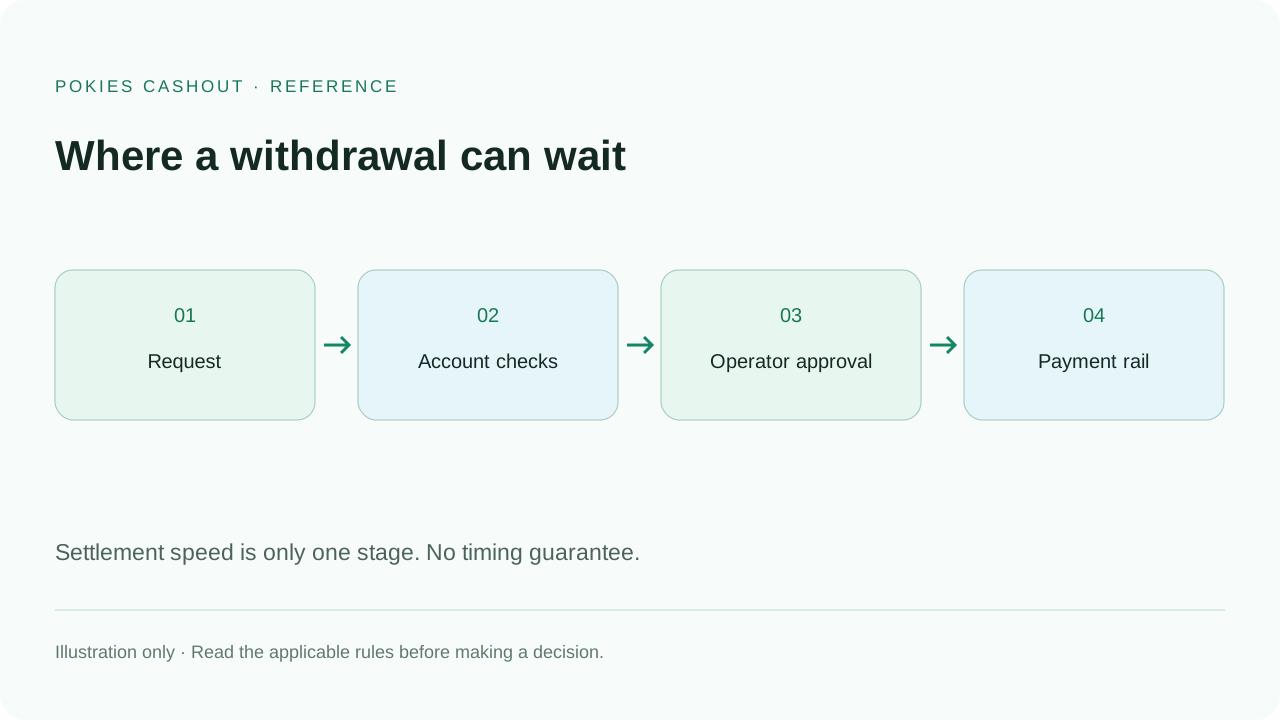
The four-stage table above is the short version. The long version is useful because a stalled payout can only be fixed at the stage it is actually sitting in, and each handover between stages has its own failure mode. What follows describes the structure of the process rather than its duration; no stage length is stated here because no stage length is a general fact about anything.
Submission. You choose an amount and a destination and the cashier accepts or refuses the request on the spot. Refusals at this point are arithmetic: an amount under the method minimum, over the per-request maximum, over an unexhausted wagering requirement, or to a destination the account has not nominated. This is the one stage that gives you an immediate answer, so read the error text rather than retrying with a different amount until something sticks. A request that submits cleanly has passed the operator's automated checks and nothing more.
The pending hold. The request is queued and not released. Nobody is looking at it, no money has moved, and the amount remains on the operator's ledger as a liability rather than as your property. The length of this hold is an operator setting written into the withdrawal clause, not a constraint imposed by any payment system, and no action on your side shortens it. Its real significance is covered in the next section.
Verification. Where documents are outstanding, this is where the request stops, and it stops silently at many operators — the status does not change to anything that tells you a human is waiting on you. A review can be unblocked only by supplying exactly what was asked for, in the format asked for, which makes it the one stage where your own speed genuinely matters. A resubmission cycle caused by a glare across a licence number costs a full round trip through someone's queue.
Finance approval. A person or a rules engine at the operator releases the payment. This stage runs on the operator's business hours in the operator's jurisdiction, which is the reason a Friday evening request in Australia can sit untouched through a weekend that was never anybody's business days. It is also where a risk flag surfaces: an unusual pattern, a large amount relative to deposits, or a bonus balance whose arithmetic has not been checked yet.
Rail settlement. Only now does the payment network get involved, and only now does any published rail speed apply. A bank payout enters your bank's clearing cycle, a card credit enters the scheme's refund flow, a chain transfer waits for confirmations. Three clocks therefore govern one payout: the operator's own window, somebody's business calendar, and the rail's settlement time. Advertised payout figures almost always describe the third, which is the smallest of the three and the only one nobody controls.
Instant describes a property of a payment rail: once a payment has been released, the network delivers it in seconds rather than in business days. That claim can be perfectly true and still have no bearing on your experience, because it begins measuring at the moment the operator finishes and your waiting began four stages earlier. A site advertising instant withdrawals is making a statement about stage five while you are standing in stage two or three.
This is why the useful question to put to support is not how long withdrawals take. It is narrower and gets a narrower answer: what is the stated pending window, is my verification complete as at today, and what hours does the finance team keep. Three answers, each verifiable, each attributable to the operator rather than to a review site. An operator that will answer all three in writing has given you something an advertised figure cannot.
There is a second reading of instant worth separating out. Some cashiers use it to mean an automated release path for requests under a threshold and from fully verified accounts, which skips the manual approval stage rather than the rail. Where that exists it is genuinely significant, and the conditions attached to it — the amount ceiling, the verification state required, whether a bonus-touched balance is excluded — are the conditions that decide whether it applies to you. Ask what the threshold is and what disqualifies a request from the automated path, because the answer is usually the whole offer.
The existence of a reverse control inside the pending window turns a waiting period into an exposure period. Pressing it does not create a new transaction: it deletes the withdrawal request and credits the amount back to the playable balance, which means the money becomes stake again rather than moving anywhere. On most cashier screens it is the easiest action available, and it sits next to a link to the lobby. Whether anything stands between the tap and the credit is an operator setting written into the withdrawal clause, not something printed on the button.
The damage is not a single large mistake, it is a loop. The amount returns to the balance, part of it goes back into the pokies, a smaller amount is re-requested, and the window restarts on the smaller figure. Each pass feels like a separate decision; the sequence is what empties the account. The cause is unequal friction — requesting the payout took deliberation, a method choice and sometimes a document, while undoing it takes one tap at the exact moment the pending amount is the only money in sight.
Four levers close the window and they differ sharply in reliability. A manual flush control, where a cashier offers one, pushes the request out of the queue into processing and permanently removes the reversal option; it changes the state of the system rather than relying on your resolve later, which makes it the strongest action available. Withdrawing the entire balance removes the comparison that makes reversal attractive, because a partial withdrawal leaves a stake to lose and a pending amount available to rescue it with. Asking support in writing to mark the request non-reversible works at some operators and produces a useful record either way. Signing out of every session is the weakest of the four and still better than willpower at the far end of a long window.
One habit belongs on a separate line because it recreates the hazard after you have avoided it: do not deposit again to keep playing while a payout processes. A fresh deposit beside a pending request is the exact configuration in which reversals happen, and at some operators it raises new questions about the pending amount under the closed-loop rule. It is also worth knowing that reversals are not invisible — the transaction history keeps the request, the cancellation and the re-request as separate timestamped lines, and in a later dispute the order of your own actions forms part of the facts. The pending and reversal page works through the bonus interactions and the two exits that hand money back without you pressing anything.
Bonus terms run to thousands of words and almost all of it is boilerplate. Three clauses do the actual work.
A wagering multiplier needs a basis. At 35×, a A$100 bonus alone requires A$3,500 credited turnover; a A$100 deposit plus A$100 bonus requires A$7,000. It is double only when the two amounts are equal. Use our wagering guide and calculator to compare the actual amounts.
Game contribution is specified in the particular bonus terms. At 10% contribution, ten dollars of play credit one dollar toward the requirement. A non-contributing game and a prohibited game are not necessarily the same; read both the weighting and exclusion rules.
A maximum cashout restricts the withdrawable amount from a promotion. Convert it to dollars using the exact stated basis. A high percentage with a cap is not automatically worse than a lower percentage without one; the other rules and possible outcomes matter.
Wagering requirements are quoted as a multiplier because a multiplier sounds like a fee. It is not a fee, it is a workload, and the workload is measured in turnover rather than in money you have to find. Turnover counts every wager placed, including wagers funded by returns from earlier wagers, which is why a requirement can be many times the deposit that triggered it without the player ever adding more funds. The amount at risk is your balance; the amount counted is the sum of all stakes it passes through.
Game weighting rescales that workload and it is the single most under-read field in a promotion. At a stated 10% contribution, ten dollars of credited stakes advance the requirement by one dollar, which multiplies the turnover you have to generate tenfold against a 100% game. A requirement that looked moderate against the headline becomes a different proposition once weighting is applied, and the weighting table is published per promotion rather than site-wide, so the figure from a different offer is not transferable. Note also that a game weighted at zero and a game prohibited under the terms are not the same category: the first wastes the stake, while the second can breach the promotion. Read the weighting table and the exclusion list as two separate documents, because that is how they are enforced. The game weighting page works through how contribution is credited.
The maximum bet rule is the clause most likely to end a balance outright, and it does not need you to be reckless. It caps the stake per spin or per hand for as long as any wagering requirement is outstanding, and it is typically enforced after the fact by a review rather than by the game refusing the bet. A single spin above the cap, including one placed by an autoplay setting or by a bonus-buy feature priced above the ceiling, can be grounds for voiding the balance built on it. Find the figure, write it down, and check it against the stake you actually use rather than assuming a comfortable margin. The maximum bet rule page covers how the enforcement works.
Maximum cashout is the clause that prices the whole offer, and it is the last one most people read. A cap limits what can be withdrawn from the promotion regardless of the balance the promotion produced, with the remainder removed at the point of withdrawal rather than when it is won. Convert the cap to dollars using the exact stated basis — a multiple of the deposit, a multiple of the bonus, or a flat figure — before comparing two promotions, because a headline percentage is comparable only after the cap has been applied to it. A smaller offer with no cap can be worth more than a larger offer with one, and the arithmetic is quick enough to do in the calculator before accepting anything.
The useful reading order is the reverse of the document's own. Start with the maximum cashout, because it tells you the largest sum the promotion can ever pay you and therefore whether the rest is worth reading. Then the maximum bet, because breaching it costs everything. Then the weighting table, because it sets the real workload. Then the expiry, because an unfinished requirement at expiry usually removes the balance attached to it. The wagering multiplier itself comes fifth, which is the opposite of how it is advertised.
Identity review can be legitimate, but a document request alone does not establish trust. Verify the organisation and secure channel before sharing sensitive information. The actual document list and review process depend on the provider.
Two details worth checking are the account name and address. The name on the account must match the name on the ID and on the payment method, exactly — a shortened first name is enough to trigger a resubmission cycle costing days. And the address on the proof must match the address on the profile, which catches everyone who has moved and not updated it.
Registration asks for almost nothing and a withdrawal asks for everything, which reads as obstruction and is mostly structure. Anti-money-laundering obligations attach to the point at which value leaves the business, so the checks are built around the payout rather than the signup, and a frictionless registration is also a commercial decision nobody is going to reverse. The practical consequence is that the verification queue is populated by people who have already won and are already waiting, which is the worst possible moment to discover that a utility bill is four months old.
Assembling the pack before you need it costs one evening and removes the only delay in the pipeline that is genuinely yours. Photograph the identity document on a dark non-reflective surface in daylight with all four corners inside the frame; a phone photograph taken that way is accepted more often than a flatbed scan, because scanners flare across the laminate over the data line. Download proof of address as a PDF from internet banking or the utility's own portal rather than screenshotting the app, since a reviewer is looking for the issuer's name, your name, your address and a date, and an app screenshot usually loses at least one of them. Keep the set in one folder with the dates in the filenames so you can tell at a glance when a document has aged out of a stated window.
Two fields cause more resubmissions than the photography. The name must match exactly across the account profile, the identity document and the payment method, and a shortened first name or a missing middle initial is enough to start another round trip. The address on the proof must match the address on the profile, which catches everyone who has moved and not updated it, and the fix is to correct the profile before submitting rather than to argue the point afterwards. Where a payment method is registered in a different form of your name — a wallet opened years ago, a card in a maiden name — resolve that with the provider first, because the operator cannot accept a mismatch it is obliged to query.
Redaction is worth getting right rather than skipping. A card image should show the first six and last four digits with the middle obscured and the security code covered entirely; a statement should show the issuer, the account name and the transaction line relevant to the deposit, with unrelated transactions and the full account number covered. Nothing legitimate requires a full card number, a complete security code or an unredacted statement, and every extra field you send is a field sitting on an offshore server for as long as that company exists. The accepted documents page sets out what a redacted set contains for each method family.
Where to send it matters as much as what you send. Upload through the account's own verification screen while signed in, never as an email attachment to an address supplied in a chat message, and never through a link in an unexpected email. A document request is a normal part of a payout and also the single most convincing pretext available to someone impersonating an operator, which means the channel has to be one you navigated to yourself. If a request arrives by any other route, log in independently and check whether the account is actually asking for anything.
Identity verification asks who you are. A source-of-funds request asks where the money you deposited came from, and it is a separate process with a separate evidence standard. It is normally triggered by a threshold rather than by suspicion — cumulative deposits, a single large payout, a deposit pattern that does not match the account's history, or a payout destination in a different name or country from the deposit. The thresholds vary widely between operators and are rarely published, which means the only reliable signal is the request itself.
What satisfies it is documentary evidence of income or accumulation rather than an explanation. Payslips, a tax assessment, a bank statement showing salary credits, a settlement statement from a property sale, or an exchange statement showing the acquisition of a crypto holding. A written account of where the money came from, however truthful, is not evidence and will be returned as insufficient. Where the funds came from an unusual but legitimate event, the useful document is the one a third party issued at the time.
Two points about scale. A source-of-funds review is a human process and a slow one, and it sits in front of the payout rather than beside it, so a large win can be held while it runs even where nothing is wrong. That is an argument for understanding the per-request caps before deciding how to split a large payout, since one request at the cap maximum is more likely to attract the review while several smaller ones multiply the pending windows instead. Neither choice is obviously correct; the source of funds page sets out what each request is actually asking for.
Sponsored · Safe Casino · 18+
+250% welcome bonus
Safe Casino welcome offer. Check the qualifying deposit, bonus cap, wagering and eligibility before accepting.
Withdrawal limits are published as a set rather than as a number, and they stack. A per-request minimum and maximum applies to each submission, and the minimum is the one that catches small balances. A daily, weekly or monthly ceiling applies to the total across requests, and those periods are usually rolling rather than calendar-aligned, which is a different thing from how most people read them. Each ceiling is published per payment method, so changing rails changes the arithmetic, and a request fails against whichever limit is lowest without the error telling you which.
Where a balance exceeds a period ceiling, the payout becomes a schedule. Divide the amount by the lowest applicable ceiling and the quotient is the number of separate requests you will be making, each with its own pending window and its own approval step, with the undrawn remainder sitting in the playable balance between slices. That remainder is the part worth planning for, because it is reachable from a phone for the whole duration of the schedule and the reversal hazard applies to every instalment rather than once. Ask whether the remainder can be held outside the playable balance until its turn, and whether the next slice can be scheduled rather than requested by hand.
A large win can also meet an instalment clause that is separate from the ordinary limits — a term specifying that amounts above a stated figure are paid in periodic portions, most commonly in the context of a progressive jackpot where the game supplier rather than the operator is the paying party. Where a jackpot is involved, the questions are who is actually paying, whether the operator is passing through a supplier's schedule, and whether the figure is paid as a lump sum or over a term. Those answers are in the game's own rules and the operator's jackpot clause, not in the banking page, and a payout of that size is a reasonable occasion to take paid advice before accepting anything in writing.
One judgement call recurs and has no general answer. Splitting a payout into several requests under a review threshold in order to avoid a review is structuring, it is visible in the transaction history, and it is a documented ground for withholding a balance rather than a clever approach. Splitting because a period ceiling requires it is simply following the published terms. The difference is the reason, it is legible to the people reading the account, and it is worth staying on the right side of deliberately. The withdrawal limits page works through how the ceilings stack and how to count the instalments.
Almost every escalation that fails does so because it was aimed at the wrong stage. Before contacting anybody, establish which of two systems is holding the money. If the cashier shows the request as pending, queued or under review and your bank shows nothing at all, the operator has it and the payment rail has not been touched. If the cashier shows sent, paid or processed while your bank shows an uncleared credit, the operator has finished and the remaining wait belongs to your bank, where a support ticket at the casino can achieve nothing. Those two findings lead to completely different actions.
Where the operator holds it, the next question is whether anything is outstanding from you. Check the verification screen for a document in a rejected or pending state, check the account messages rather than only your email, and check whether a wagering requirement is genuinely exhausted rather than nearly exhausted. A request sitting behind an unanswered document request is the most common stall there is and it is also the fastest to fix, because the remedy is entirely in your hands. Nothing further in the escalation sequence helps until that is clear.
With nothing outstanding and the stated window exceeded, escalate in order and in writing. Live chat first, because it produces a transcript and establishes a date; ask for the stage the request is in and the reason for the hold, in those words, and save the transcript as a file rather than trusting the widget's history. Then the operator's formal complaints procedure, which is a named process in the terms with its own address and response period and is a different channel from support. Then the licensing authority named in the footer, after you have checked that authority's own jurisdiction and eligibility rules, because a footer badge is not evidence a complaint will be heard. Keep every step dated and attach the same evidence pack each time: the request, the balance, the terms as they read on the day you submitted, and the transcripts.
Build that pack before the first message rather than after the third. Screenshots of the pending request with its timestamp, the account balance, the stated processing window on the banking page, the withdrawal clause in the terms, and the verification screen showing documents accepted. A live page can be edited and a disputed clause reconstructed from memory is worth nothing; a dated screenshot of the sentence that was in force when you submitted is the one fact the other side cannot revise. Record the requested amount and the amount actually received separately, so a shortfall can be matched against a published charge instead of argued about in general terms.
One action is never the answer, and it is the one most often reached for. Raising a chargeback on a gambling deposit in order to recover a withheld payout disputes a transaction you authorised, which is a different claim from the one you actually have, and the normal consequences are account closure, forfeiture of the balance you were chasing and a record with the payment processor that follows you to other sites. It converts a complaint about a payout into a dispute about a deposit, and you lose the second. Where a card charge itself is genuinely in dispute — a payment you did not make, or a charge that does not match what was authorised — that is a real claim and it belongs with your issuer and then with AFCA. The chargebacks page sets out the distinction, and the stalled payout checklist has the full sequence with the document list.
The governing legislation is the Commonwealth Interactive Gambling Act 2001. It prohibits providing online casino-style gaming to a person in Australia. Its prohibitions are directed at providers, not players: there is no offence in the Act for an Australian adult placing a bet.
Australian online casino services are prohibited to supply. The ACMA guidance explains the risks and complaint options. Do not treat an offshore licence, domestic payment logo or this site as Australian authorisation.
A dispute therefore runs: operator support, then the operator's complaints procedure, then the offshore licensor named in the footer. Available recourse depends on the operator, jurisdiction and circumstances; recovery is not guaranteed. The terms you accepted are the agreement, enforced as written, which is why the three clauses above repay reading before rather than after.
The Interactive Gambling Amendment (Credit and Other Measures) Act 2023 amended the Interactive Gambling Act, and its payment prohibition commenced on 11 June 2024 after a transition period following Royal Assent on 11 December 2023. From that date an operator of an Australian-regulated interactive wagering service may not accept a credit card, funds drawn through a linked credit card, or digital currency from a customer in Australia. Three payment categories are named rather than one, which matters because a reader who remembers only the words credit card will assume a wallet or a chain transfer sits outside it. Both commencement dates are printed in the Act's own table on legislation.gov.au.
The grammatical subject of that prohibition is the operator. It is drafted as a restriction on accepting, or offering to accept, payment by those methods, and the penalty provisions run against providers rather than customers. Alongside it sit ACMA's separate and older credit betting rules: a covered wagering operator must not provide credit to you or help you obtain it from a third party, so an account manager offering to arrange funding is testing that rule rather than providing a service. None of this is legal advice and the section wording is worth reading directly.
The boundary is the part that misleads people. The prohibition attaches to the regulated services ACMA supervises, which in practice means licensed Australian wagering. An offshore casino cashier is not a member of that set with credit quietly switched off; it sits outside the framework entirely, which is why a card can still clear there and why the fact that it cleared establishes nothing about the operator. Online casino services cannot lawfully be supplied to a person in Australia in the first place, and a commencement date for a wagering payment rule does not change that. The credit card ban page works through the four misreadings that cost people money.
Which leaves the rule that will actually decline your card: your own issuer. Some credit products restrict gambling transactions in their own terms, some treat a gambling-coded transaction as cash-equivalent for interest and fees, and many banking apps carry a customer-set gambling control that applies to offshore merchants as readily as to domestic ones. The operator's error message cannot distinguish between a scheme decline, an issuer rule and a control you set yourself, so ask the issuer in writing what decline reason was recorded. And treat the decline as the finding rather than as an obstacle: reaching for the next rail on the menu does not answer the question the first one raised, it removes the party who raised it.
The workarounds deserve naming because they are presented as neutral. A credit-funded wallet, a buy-now-pay-later account, a prepaid card loaded from a credit facility, a cash advance, or somebody else's card are not one risk with five labels. Depositing from a payment method that is not yours is third-party funding, which breaches essentially every set of terms and is a documented ground for withholding a payout after a win rather than for refusing the deposit before it — the money goes in without friction and the problem surfaces on the way out. A cash advance or an instalment plan creates a separate financial obligation with its own fees that survives whatever happens at the casino. And every indirect route multiplies the identity material you have to send to prove you own it, which does not come back when the account closes. Two things never to do on any rail: do not alter a payment description to get it past a bank protection, and do not later describe a deposit you authorised as unauthorised in order to recover it.
The ATO considers the circumstances of gambling activity rather than using one rule for every person. Crypto transactions can also have tax consequences independently of a gambling result. Keep dated acquisition, disposal, fee and exchange records and consult ATO record-keeping guidance. This page does not assess your tax position.
The general position usually quoted is that a recreational gambling win is not treated as assessable income for an Australian resident, on the reasoning that it is not the product of a business or a profit-making undertaking. That framing is useful background and it is not a conclusion about you, because the treatment follows the character of the activity rather than the size of the win, and the ATO considers the circumstances of each case. This page does not assess your position and nothing on it is tax advice; the point here is narrower and practical.
The practical point is that the records are the same either way, and they are only available while the transactions are fresh. Keep dated deposits and withdrawals with the rail each one travelled on, the currency each amount was denominated in, the fees deducted at every layer, and the conversion rate applied where a balance was not held in Australian dollars. Do not add an amount in one currency to an amount in another as though they were the same unit, which is the most common defect in a reconstructed set. A statement line showing a payment to a processor is not a record of what the payment was for.
Crypto is the part where the question changes shape, because a disposal of a crypto asset can have its own consequences independently of any gambling outcome. Converting Australian dollars to a coin, sending it to a cashier, receiving a payout in the same or a different asset and converting back is a chain of events in which the asset's value may have moved at every step, and a change in asset value is a different thing from a gambling result. Retain the asset, network, amount, transaction reference and the Australian-dollar value you used for each leg, and read the ATO's own crypto record-keeping guidance rather than a forum summary of it.
If an amount is large enough that the answer matters, the right move is a registered tax agent or the ATO directly, with the records above in front of you. A professional working from a complete ledger can answer in one sitting what is unanswerable from a general page, and the cost of assembling the ledger afterwards is far higher than the cost of keeping it as you go. The tax page sets out the questions worth taking to that conversation.
Want to see how a live cashier presents its limits and methods? One click.
Play online →Three questions come up constantly in Australian casino search and they have three different right answers, which is why they live in three different places rather than being crammed into one page.
| Your question | Answered by | Why not here |
|---|---|---|
| How do I get my money out, and what do these terms mean? | This site | — |
| Which operator should I use, and is this one any good? | An operator review site | Judging operators is a different discipline with different evidence |
| How does this game work and what is its RTP? | A game reference | Game maths has nothing to do with payment rails |
The practical effect for you is that nothing here is padded with a paragraph about volatility or a ranked list of casinos to fill space. A page about PayID is about PayID. The guides compare methods and terms, never operators by payout speed — that is an operator comparison and it belongs where operators are compared.
It also means the pages are written for someone with a specific problem rather than for someone browsing. If you arrived because a withdrawal has been pending for three days, go straight to when a payout stalls and diagnose the stage; the background on this page will still be here afterwards.
It does not publish measured payout times. A credible figure would need a sustained programme of funded accounts, repeated withdrawals across methods, days of the week and account ages, at every operator being compared, repeated often enough to survive operators changing finance staffing without announcing it. Almost nobody runs that, and a single anecdote is not a processing time. What this site does instead is explain the mechanism so that an advertised number becomes interpretable.
It does not rank operators by payout speed — that is an operator comparison and it belongs on an operator site. The guides here compare payment methods and terms, which is a different question with a different answer. And it publishes no invented review scores: where a number appears beside an operator it carries an attribution, and where partner-supplied counts appear they are labelled as unverified.
The commercial side is stated rather than hidden. The operator cards, the promo strips and the popup are sponsored placements, marked as such, and clicking one may earn this site money. The placements are commercial and are not independent editorial rankings; they do not establish payment support or measured payout performance.
The two sponsored offers on this site are deliberately shown in their own terms. Safe Casino advertises a +250% welcome bonus, while WinCrown advertises 200 free spins on selected slots. The site owner supplied these headline figures. They are not equivalent amounts of cash, and neither headline establishes that you qualify. Read the promotion's full conditions before making any decision.
For a percentage bonus, start with the deposit that actually qualifies. In a hypothetical uncapped example, A$40 multiplied by 250% creates A$100 of bonus credit. That is an arithmetic illustration, not a claim about Safe Casino's deposit minimum, maximum bonus or cashout policy. If only part of a deposit qualifies, or a cap applies, the credited bonus can be different. Bonus credit can also be restricted and is not necessarily withdrawable money.
For 200 spins, find the stake per spin and the exact eligible game list. Two offers with the same spin count can have different nominal values. A release schedule may divide the spins over several days, and each release may expire. Check whether unused spins disappear and whether winnings enter a cash balance or a new bonus balance with its own wagering. Do not assume that a spin offer covers every slot in the lobby.
Write down the wagering basis, multiplier, game contribution, maximum bet, expiry and cashout limit for each offer. If one of those fields is missing, ask for it rather than filling the gap with an assumption from a general review. A screenshot of the applicable conditions and the acceptance confirmation is more useful in a later disagreement than a promotional banner alone.
Keep account eligibility separate from game eligibility. Age, location, previous claims and account ownership may affect whether a promotion is available. A banner being visible is not a promise that it can be claimed by everyone. Never create another account, borrow a payment method or misstate your details to obtain an offer. If the rules are unclear or conflict with your own limits, declining the promotion is a valid outcome.
A useful personal record separates deposits, fees, restricted credits and actual withdrawals. Record the currency of each entry rather than adding AUD and another currency as though they were the same unit. For a crypto transaction, retain the asset, network, amount and reference as well as the AUD value used by your records. A change in asset value is different from a gambling result.
For a withdrawal, record the requested amount and the amount actually received. If a fee or conversion reduces the receipt, ask which published charge explains the difference. A request displayed as approved is not the same as money arriving in your account. Preserve both status changes and the final payment reference, without making account numbers or identity documents public.
Finally, required turnover is not a budget. It includes repeated wagers funded by recycled returns and can be far larger than a deposit. The calculator explains that workload under fixed assumptions; it cannot determine what you will win, whether your funds will last or whether a bonus is a suitable choice. Personal time and spending limits come before completing any requirement.
There can be several reasons, including a bank restriction, security review or incorrect recipient details. Ask the bank for the actual cause and do not disguise the payment to bypass a protection.
No. A request may also involve verification, operator approval and limits. Payment-rail speed alone is not an end-to-end payout promise.
They are different benefits. Check the qualifying deposit and cap for a percentage bonus, and the eligible slots, spin value and expiry for free spins. Both may impose wagering or withdrawal conditions.
Do not assume the cause or send money to a supposed recovery service. Preserve records, check official notices and contact your bank if a payment may be fraudulent.
Tax treatment depends on the facts and the type of transaction. Crypto disposals may require records even when connected to gambling. Seek ATO guidance or qualified advice for your circumstances.
BetStop covers licensed Australian online and telephone wagering providers. Its scope does not extend to every offshore casino. Gambling support can help you choose additional protections.
Because deposit and withdrawal support are configured separately, and some rails cannot carry a payout at all. A voucher is a spent code rather than an account, a device wallet has no receive function, and a payment mandate only pulls. Read the withdrawal tab before depositing, not after winning.
A term returning funds by the route they arrived on, up to the amount deposited, with anything above that paid by a nominated alternative. It exists for anti-money-laundering reasons. Depositing on a one-way rail means the closed-loop leg cannot be honoured, so the whole payout falls to the alternative and its verification.
No. It reports the account name registered against an identifier, which catches a transcription error or a stale saved payee. Offshore casino traffic is normally addressed to a payment processor's registered trading name, so an unfamiliar name is the ordinary case on that rail rather than a signal you can act on.
Anti-money-laundering obligations attach to the point at which value leaves the business, so the checks are built around the payout. A frictionless registration is also a commercial decision. The consequence is that the verification queue is full of people already waiting on money, which is why the pack is worth assembling on the day you register.
Usually a threshold rather than suspicion: cumulative deposits, a single large payout, a deposit pattern that does not match the account's history, or a destination in a different name or country from the deposit. Thresholds vary and are rarely published. What satisfies the request is third-party documentary evidence of income or accumulation, not a written explanation.
The maximum cashout, because it states the largest sum the promotion can ever pay you and therefore whether the rest is worth reading. Then the maximum bet rule, because breaching it can void the balance. Then game weighting, which sets the real turnover workload. The advertised multiplier is the least informative figure in the document.
Where a period ceiling requires it, splitting is simply following the published terms. Splitting deliberately to stay under a review threshold is structuring, it is visible in the transaction history, and it is a documented ground for withholding a balance. The difference is the reason, and the reason is legible to whoever reads the account.
No. A chargeback disputes a deposit you authorised, which is a different claim from the one you have, and the usual consequences are account closure, forfeiture of the balance you were chasing and a record with the processor. Where a card charge itself is genuinely in dispute, that claim belongs with your issuer and then with AFCA.
It attaches to the Australian-regulated interactive wagering services ACMA supervises, and its payment prohibition commenced on 11 June 2024. An offshore casino cashier sits outside that framework rather than inside it with credit disabled, so a card clearing there establishes nothing. Online casino services cannot lawfully be supplied to a person in Australia at all.
Explore the comparisons